
Listener goal communication is the difference between saying something clearly and being understood accurately. Most professionals focus on what they want to say—but strong communicators organize their message around what the listener needs to understand, decide, or feel. When your message matches the listener’s goal, communication lands faster, with less friction, and far less repetition.
This skill allows you to response to what the listener actually needs in that moment. When speakers miss this, even strong communicators sound scattered, defensive, or long-winded.
And no—this is not about being “better at talking.” It’s about being better at calibrating. This is definitely a skill that can be learned, practiced, and perfected. Professional communication coaching is a great place to start your journey.
The Hidden Question Behind Every Interaction
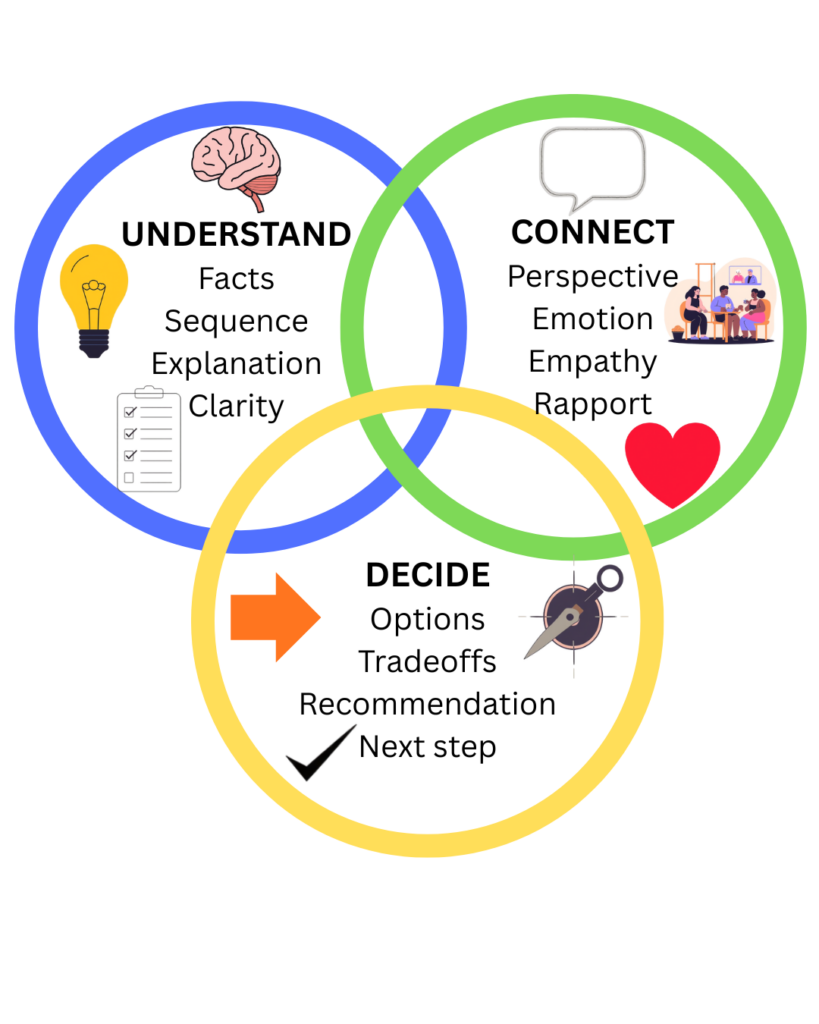
Whether someone asks a direct question or just opens the conversational door, their brain is usually primed for one of three goals:
1️⃣ UNDERSTAND
They want clarity, facts, sequence, or explanation.
2️⃣ DECIDE
They want help choosing, prioritizing, or evaluating options.
3️⃣ CONNECT
They want empathy, validation, or shared perspective.
Listener goal communication means your job isn’t to say everything you know. Your job is to serve one primary listener goal.
Why Smart Professionals Still Miss the Mark
Here’s the frustrating part: most people are trying to be helpful.
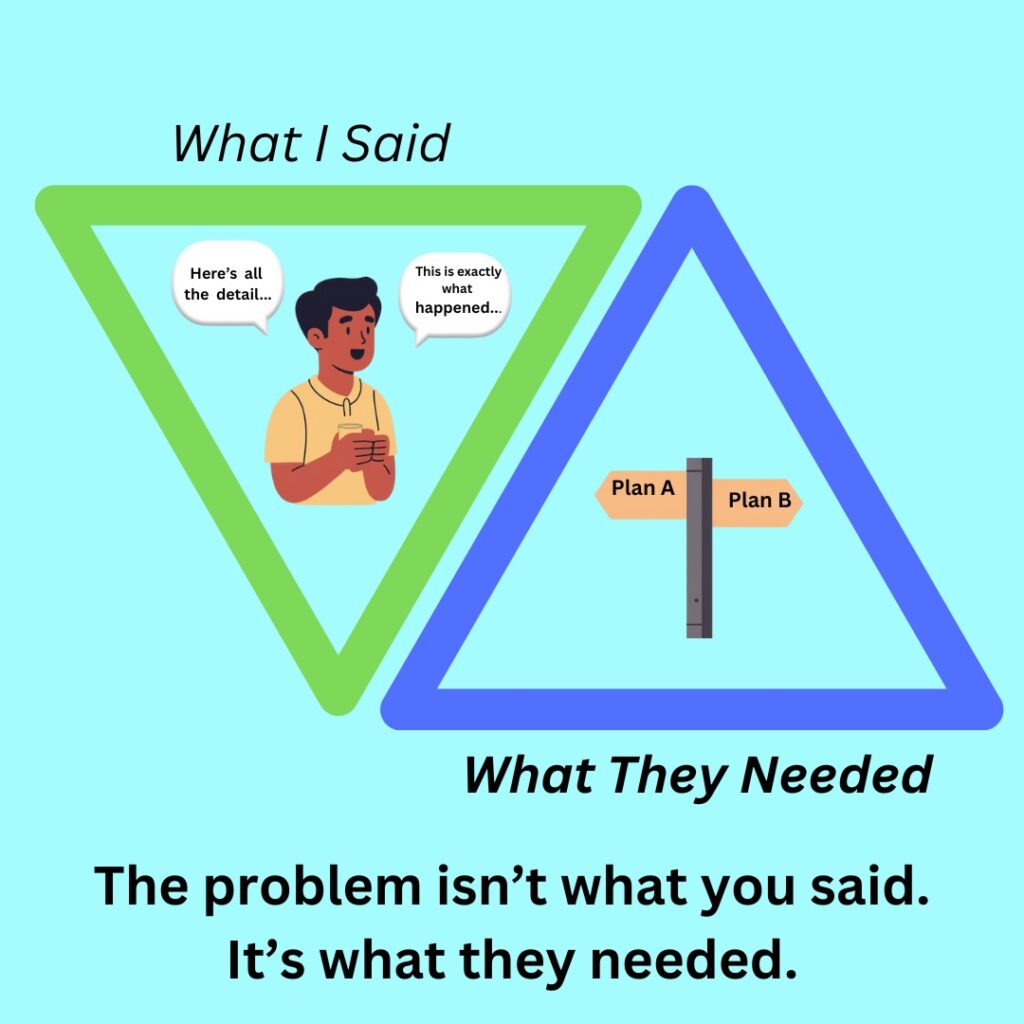
But when the speaker defaults to their goal instead of the listener’s, things go sideways.
Common examples:
- Explaining details when reassurance was needed
- Sharing emotions when a decision was required
- Offering options when someone just wanted clarity
This is especially common in:
- Leadership communication
- ADHD-related verbal processing
- High-stakes or emotionally loaded conversations
The brain under pressure talks first and organizes later. If the listener’s brain can’t process what you’re saying, they stop tracking—even if what you’re saying is intelligent. Insights on cognitive load explain how information overload disrupts understanding. Listener goal communication flips that order.
Choosing the Right Communication Framework
Different listener goals require different delivery styles. Verbal frameworks give your brain a structure to work from. They reduce cognitive load, keep you on track, and help your listener follow your thinking without effort. If you want a deeper look at how structured thinking improves clarity and confidence, you can also explore our CLEAR Strategy for making your point.
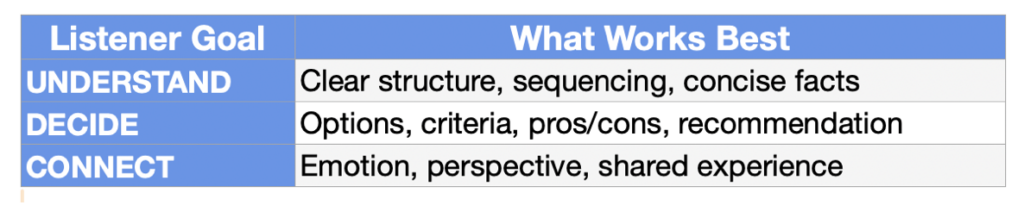
When your framework matches the listener’s goal, your message lands faster and with less resistance. That’s not luck. That’s neuroscience—and exactly what leaders learn in our Leadership Communication program.
Different listener goals require different delivery styles.
Common Communication Misfires (and Why They Happen)
Let’s name the usual suspects:
❌ Misfire #1: Explaining When Connection Was Needed
You give facts. They wanted empathy. Result: “Why aren’t you listening?”
❌ Misfire #2: Connecting When a Decision Was Needed
You share feelings. They wanted a recommendation. Result: “Can we get to the point?”
❌ Misfire #3: Deciding When Understanding Was Needed
You jump to conclusions. They needed context. Result: “That’s not what I asked.”
None of these mean you communicated badly. They mean the listener goal was mismatched.
Many professionals rely on storytelling because it feels natural. But without structure, stories often include irrelevant details, miss the point, or leave the listener unsure what to do next. This is exactly why we teach storytelling as a strategic communication skill in our Storytelling Essentials program, not a personality trait.
What If Someone Is “Just Talking”?
Not every moment has a clear question—but almost every moment still has a listener goal.
When someone is processing out loud, they’re often:
- Seeking UNDERSTANDING (organizing thoughts)
- Seeking CONNECTION (being seen)
- Moving between goals mid-sentence
This is where skilled communicators pause and calibrate. And yes—some people already do this instinctively, while others were never taught it.

The Power of Micro-Calibration
Before launching into your response, try a quick internal check—or say it out loud:
- “Do you want help deciding—or just understanding this?”
- “Are you looking for my opinion, or just a sounding board?”
- “Do you want the details, or the takeaway?”
That tiny question can save minutes of miscommunication because micro-calibration is not indecision—it’s intention.
One-Sentence Practice Prompt
Before you speak, silently name the listener’s goal—UNDERSTAND, DECIDE, or CONNECT—and shape your first sentence to match it.
That’s it. That’s the practice.
Why This Matters for Professional Communication
At Speech Matter Expert, we see this pattern daily with adults who are:
- Brilliant but misunderstood
- Clear thinkers who sound scattered under pressure
- Leaders whose messages don’t land the way they intend
Listener goal communication gives people a repeatable way to organize spoken language in real time—especially under stress.
If this sounds familiar, let’s talk. You don’t need more confidence—you need the right structure. Reach out here to schedule a consultation.